
Since multilateral trade creates a stable, peaceful world, normalisation of bilateral trade between India and Pakistan will start a series of peace building measures, especially along the bordering areas of both states which is the worst affected from the on-going conflict, say Riya Sinha and Shehzad Poonawalla.

Rediff.com's Vipin Vijayan, who is travelling with Prime Minister Manmohan Singh, says India will make efforts to elevate relations with Thailand to a strategic partnership.
There is a sense of relief in Beijing that Modi will be at the helm of affairs in Delhi at a critical juncture in the geopolitics of the region, says Ambassador M K Bhadrakumar.
'As the first leaders of their respective countries born after Indian Independence and the Chinese Liberation, Modi and Xi would be expected to have the ability to overcome the traditional mindsets and the hierarchical nature of their official/bureaucratic establishments,' say Alka Acharya and Jabin T Jacob.
India and Vietnam on Monday inked seven pacts, including one to enhance cooperation in the strategic oil sector, as they called for "freedom" of navigation in the South China Sea, a remark which could irk China, which has been claiming territorial sovereignty over the high seas.

Modi said Nepal and India can benefit if they cooperate and work together for the promotion of five Ts: Tradition, Trade, Tourism, Technology and Transport.

Prime Manmohan Singh on Thursday sought Chinese investments in manufacturing and infrastructure sectors in India and called for market access in China for Indian IT and Pharmaceutical firms.

The two countries also asked all nations to stop cross-border movement of terrorists and asserted that a decisive collective response from the international community without 'double standards and selectivity' was required to combat the threat of terrorism.

The Indian government should resist the temptation to make a grand gesture of friendship towards Nawaz Sharif, says Shyam Saran

India should enhance its economic, cultural and defence ties with Mongolia. It is high time Modi should focus on gaining clout in smaller Asian countries such as Mongolia. It is in this context, India's engagement with Mongolia would give much-needed impetus to India's foreign policy, says Sana Hashmi.
'Only when China treats India as an equal can we consider them real friends.'

Pak seeks US help to ease tensions with India.

Bharatiya Janata Party's prime ministerial candidate Narendra Modi's belated attempt to project himself as a statesman and a man of reason in his interviews to ANI and TV9 is being viewed with dollops of scepticism by his critics and political opponents. Anita Katyal reports.

Do Modi's foreign visits actually serve India or they nothing more than expensive tools for domestic positioning and image-building, asks Shehzad Poonawalla.

The comments come at a time when the Supreme Court-constituted Special Investigation Team has detected funds worth about Rs 4,479 crore (Rs 44.79 billion) held by Indians in a Swiss branch of HSBC bank, while unaccounted wealth totalling Rs 14,958 crore (Rs 149.58 billion) have been traced within home.

Prime Minister Narendra Modi and Sri Lankan President Maithripala Sirisena on Monday held talks at Hyderabad House

Moving ahead with their new mantra -- Chalein Saath Saath: Forward Together We Go -- Prime Minister Narendra Modi and United States President Barack Obama on Tuesday vowed to deepen cooperation in every sector for the benefit of global stability and people's livelihoods over the next ten years.
The council resisted intense pressure from the powerful manufacturing, pharma and other trade lobbies that have urged the Obama administration to enact punitive measures against India for a laundry list of alleged intellectual property and patent violations.

Amid souring ties, the president visited Beijing for three days. On his return to India, a hope of better ties has arisen, says senior correspondent R Rajagopalan, who travelled with Pranab Mukherjee to the Asian superpower.

"This will be the first dinner for a foreign dignitary at the White House under this administration. So, we think that's very significant," a senior administration official told reporters at the White House on the eve of Modi's arrival.

India and Japan have a shared interest in countervailing China's hegemonic ambitions in Asia. Although neither has an interest in forming an overt anti-China alliance, Tokyo and New Delhi feel increasingly obligated to work together to find ways to guard against a muscular Beijing's power sliding into arrogance, says Brahma Chellaney.

'It is in the interest of both sides that the visit of the US President is seen as being successful. Both sides have invested considerable political capital in it. This rapid exchange of visits and the decisions taken have to be justified, beyond the symbolism, which is no doubt important in itself. This opportunity to impart a fresh momentum to ties should not be missed,' says former foreign secretary Kanwal Sibal.

"We are committed to building a new India. We have to do this as early as possible," he said.

'India alone cannot walk the path of peace. It also has to be Pakistan's journey to make,' says Prime Minister Narendra Modi at the government's geo-political flagship initiative "Raisina Dialogue-II".

Here's the full text of President Ram Nath Kovind's customary address to the joining sitting of Parliament on the first day of the budget session.

India has undertaken a number of structural reforms.

'This is such a dynamic time for our entire community.' Ami Bera tells Aziz Haniffa/Rediff.com what his selection means for desis in America.

Tillerson said China's behaviour and action is "posing a challenge to the rules-based international order".

'The question remains: Was the Obama visit truly a success? Only the future will tell us if the "breakthrough" in the nuclear liability issue will concretise into electricity.' 'As importantly, it will be interesting to watch how India's relations with China will evolve in the months to come.'
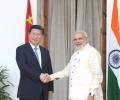
With the continuing stand-off in Ladakh casting a shadow over the Sino-India talks, Prime Minister Narendra Modi on Thursday raised 'serious concerns' over the repeated incidents along the border and sought an early settlement of the boundary question.

The 'Missing link in India's Act East Policy', as India's former foreign secretary Shyam Saran calls it, needs to be filled sooner rather than later, says Dr Rahul Mishra.
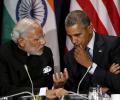
'Big countries do not agree on every set of issues.' 'Look, one of the differences in the relationship is that when we do not agree, we are sitting down and talking to each other.'

Overseas airlines can operate unlimited number of flights into and out of India.
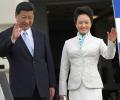
'India and China have to make concrete progress with regard to the border issue, addressing the trade deficit, and facilitating people-to-people interactions. This has to happen in the next two, three years.' China expert Tansen Sen tells Sheela Bhatt/Rediff.com how India and China can take their relations to the next level.

'If, as appears to be the case, India is on way to 'mending fences' with China, and China is equally desirous to 'reset' the relationship, this could be a self-reflexive moment in India's positioning vis-a-vis not just the Dalai Lama, but also the Tibetan issue and China as a whole,' points out China expert Alka Acharya.

'By not letting bankrupt banks fail, we have discouraged ordinary folk from taking precautions while choosing their bank or at least when they hear bad news about their bank,'says S Muralidharan, former MD, BNP Paribas.
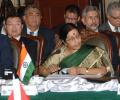
India on Wednesday extended a hand of friendship to Pakistan, saying it was time the two countries display "maturity and self-confidence" to do business with each other.

Following is the full text of Prime Minister Manmohan Singh's speech at the Central Party School in Beijing on Thursday:
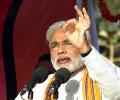
'Both reflect prejudice and short-sightedness peculiar to Mr Modi's way of thinking.'
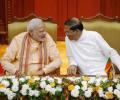
'What we have heard from the Sri Lankans is their desire to have a foreign policy that allows Sri Lanka to best advance its own interests rather than a foreign policy that relied solely on one relationship.' 'We think this is an attitude that makes a lot of sense. India and Sri Lanka have many areas of shared interests, and it's certainly welcomed by us to see that deepening of those ties.'
